Infinity Series
Sculpture · 2023-2026
reused paper, aluminum wires, fish line
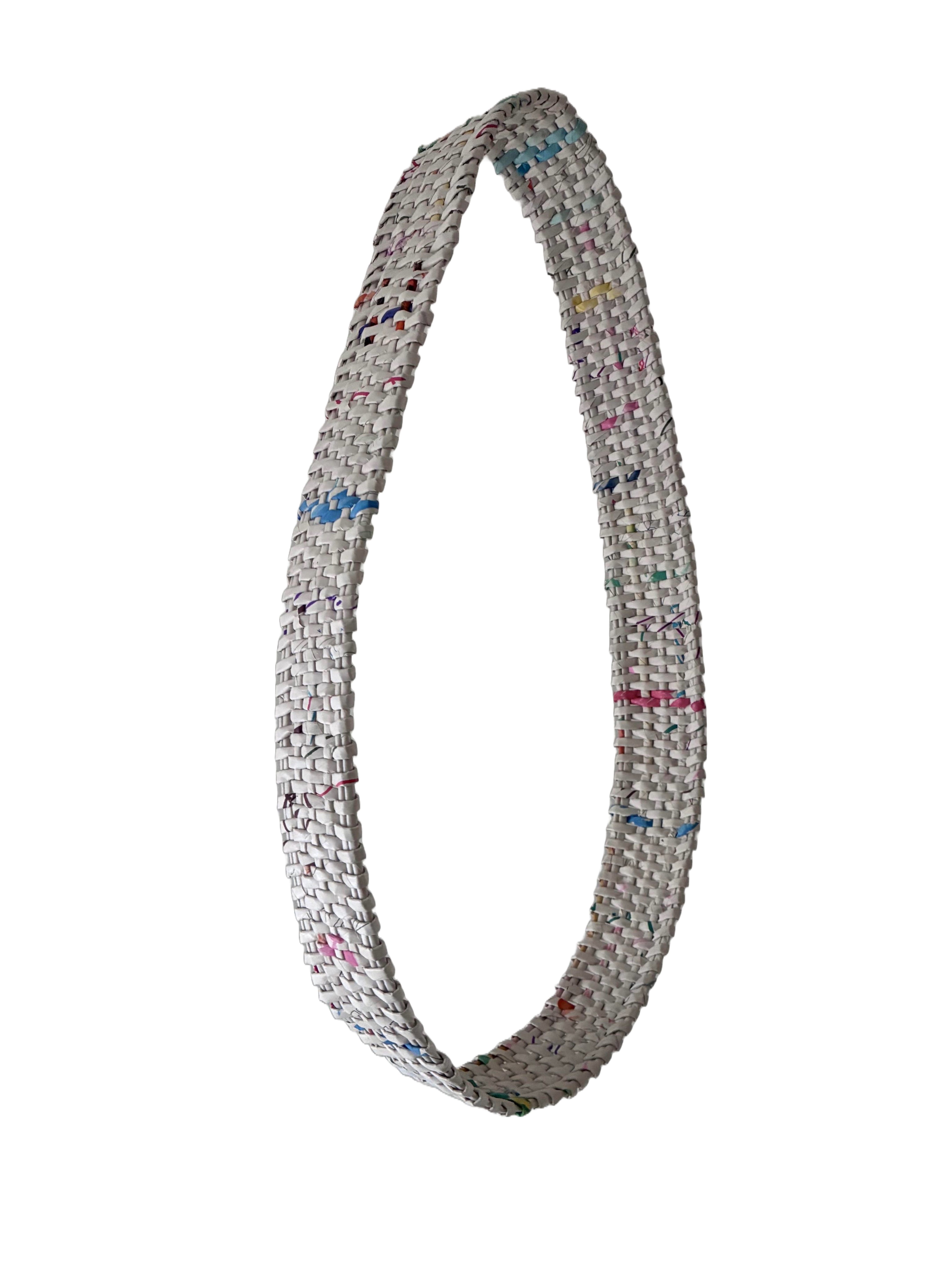
This sculptural work extends the Infinity Series paintings into three dimensions, translating its system of rotational loops into woven form. The series comprises ten structures (0–9), each derived from a loop defined by a specific number of 180-degree rotations, yielding figures that are both constrained and infinitely variable.
The loops are constructed from rolled sheets of recycled paper, drawings made by my young son, woven into continuous bands. What was once fragmented and ephemeral is reconfigured into a robust, interdependent structure.
To transform one loop into another, it must be broken and rejoined. Here, that process is literal. The work draws on this act of re-binding as both structure and meaning, suggesting continuity through rupture and return.
Mounted on salvaged sycamore and supported by reclaimed bamboo, the sculptures foreground materials marked by use, damage, and neglect. In doing so, they propose a revaluation: what is overlooked or discarded always carries form, meaning, and the possibility of renewal.
Infinity Series
Painting · 2020
acrylic on canvas
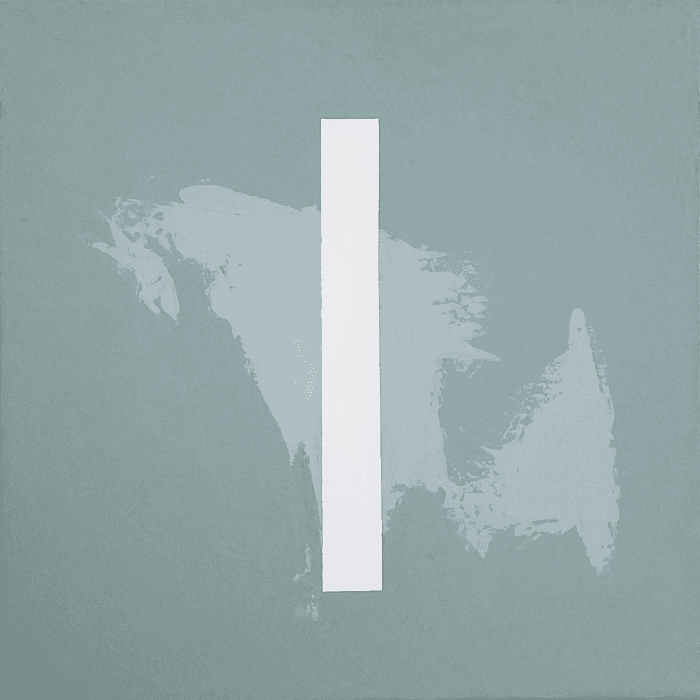
Infinity Series presents one set of serialized variations on the infinity symbol. The traditional infinity symbol can be conceptualized as a strip with a single 360 degree twist in it and then joined together at the “edges.” In the final shape, these conceptual “edges” disappear, hence the infinite quality of the loop. While experimenting with creating paper infinity loops, I noticed that adding rotations does not affect the shape in a determinate or regular way. Producing two-dimensional shapes from these loops involves creative decision-making. Meanwhile, because the resulting two-dimensional figures at some points inevitably rotate 180 degrees in one direction and then back again in the opposite direction, reading the net number of rotations in the representations of the loops requires careful attention.
Thus, these figures strike a balance between more abstract and more literal number systems. Each symbol in Infinity Series could take an infinite number of forms—but not any and all forms: the range of possible forms for these infinity figures is constrained by the number of 180 degree rotations in the loop. In this sense, the figures are literal representations of the numbers which they represent according to the number of 180 degree rotations. On the other hand, because the number of rotations can be difficult to discern, the “Infinity Numbers” pose an etymological mystery, similar to the opaque Brahmi numerals which underlie the popular Arabic numeral system. In short, Infinity Series presents a certain set (0-9) of an infinite series (0-∞) of serially constrained but infinitely pluriform infinity loops.
Beyond shape, the figures also play on the paradox of the apparent loop in the spectrum of perceivable color. Color wheels appear to loop, at the breakpoints of perception. The “edges” of infrared and ultraviolet wind through an invisible meeting place which we represent with magenta. Like the numbers of Infinity Series, magenta is both determined by and opaque to the infinities (in multiple dimensions) which it, therefore, somewhat is and somewhat represents. Infinity series alludes to this mind-blasting absurdity by rotating through the color wheel at roughly 40 degree intervals. The foreground and background colors are offset by roughly 150 degrees on the color wheel. Interestingly, it is only the difference in their relative positions within this infinite loop which render them distinguishable.
These considerations of Infinity Series' treatment of numbers, forms, and colors apply to a variety of conceptual realms—social, spiritual, comsological, etc. Likewise, the art-making process also gave rise to some interesting hermeneutical reflections. To change the form of one infinity loop into another, the loop has to be broken and rejoined—the etymological meaning of the word "religion". It is part of the paradoxical nature of time that newness flows infinitely and instantaneously from oldness. Perhaps it reflects a redemptory truth encoded into reality and perception: “The old has passed away; behold, the new has come.” (2 Corinthians 5:17b)
Stop Emptiness? Stop in Vain
断空?空断
Installation · 2010
cotton threads, spools of thread, spotlight
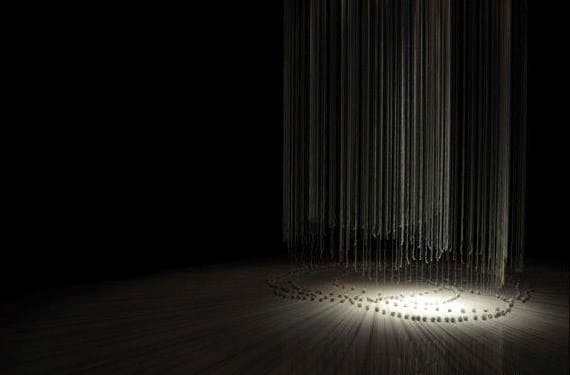
Things are limited, while emptiness is unlimited. Can any one establish an end to emptiness? Or are such apparent ends all established in vain? The installation, "Stop Emptiness? Stop in Vain" (断空?空断) presents these philosophical questions.
The exhibition space is one of the broadest emptinesses for any artwork. In this case, that emptiness is divided by numerous threads. The pull of gravity on the soft threads has made them solid, vertical entities. The various lengths of the threads create an impression that their respective spools were cut while falling in mid-air. However, the spools are still connected to their threads via the shadows of the threads on the ground.
The Chinese character used in the title, "断” literally means "stop” or "cut”, but it also figuratively means "judge” or "decide.” It is a word which can be used to reveal the state of a person's mind. Thus, the title can also be translated as, "Judge emptiness? Judge in vain."